
 © ©Jens Ahner
Climate Protection, Growth, Transformation—How Can We Move Forward in the Building Sector?
Goals and Priorities of the New Federal Government
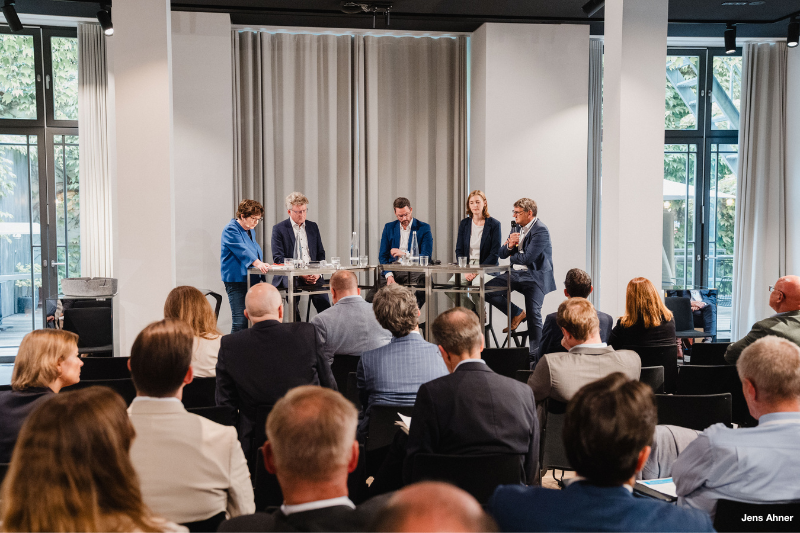
“Renovation should be fun again”—with this appeal, Stephanie von Ahlefeldt, head of the relevant department at the Federal Ministry of Economics, is calling for a more relaxed approach to communication surrounding energy-efficient building renovation. She hopes the debate will be conducted in a more objective manner. State Secretary for Construction Dr. Olaf Joachim emphasizes that funding is fundamentally secured, but at the same time calls for a reduction in excessive regulation. An “excessive need to regulate things,” he says, hinders implementation. Holger Lösch, deputy chief executive of the BDI, agrees that policymakers must have the courage to make decisions and provide clarity. This is of fundamental importance for property owners and investors. It is also important to pay closer attention to the interconnections between climate protection, social issues, and economic growth.
Leverage for More Building Renovation and New Housing Construction
In the discussion on policy levers, one thing is clear: Rapidly established political framework conditions are needed so that the renovation rate no longer stagnates and the investment backlog is cleared. Johanna Coleman, chair of the BDI initiative, called for clarity in legislation and funding—specifically regarding Section 71 of the Building Energy Act (GEG), the EU Energy Performance of Buildings Directive (EPBD), and the Building Support Act (BEG). Members of the Bundestag Nicklas Kappe (CDU/CSU) and Helmut Kleebank (SPD) advocate for technology-neutral solutions and political continuity that prioritizes the “worst-performing buildings.” The political framework must be further developed without disruptive changes, as these are considered counterproductive. Dr. Julia Verlinden of Alliance 90/The Greens emphasizes that, in her view, the GEG regulations on heating systems are already technology-neutral today. She urges the federal government to submit the Climate Social Fund plans quickly, as several billion euros in funding are at risk. In the future, she says, funding must be more socially tiered and should place greater emphasis on serial renovations.
Opportunities and Catalysts for Climate Neutrality in Buildings
Greater focus should be placed on measures that can be implemented quickly. Representatives from business, academia, and federal politics agree: there are “low-hanging fruits” and low-investment measures that can yield progress in the short term. Dr. Rainer Ortmann, Head of Energy Policy at Bosch and Site Manager, explains that the industry is ready to deliver what policymakers request. Prof. Andreas Holm, Director of the FIW Research Institute, emphasizes that low-hanging fruit need not be sought exclusively in the boiler room: insulation measures—particularly for the top-floor ceiling and basement ceiling insulation—could quickly yield significant improvements. Dr. Rottwilm (SPD), a member of the Bundestag, highlights how potential at the local level continues to be squandered due to overly stringent requirements and delays—particularly in the new construction sector—as he himself observed during his tenure as mayor. Hanna Steinmüller, a Member of the Bundestag for Alliance 90/The Greens, also points out that all too often, opportunities that could be quickly realized—such as hydraulic balancing—are not sufficiently exploited.
In the end, there was consensus among the participants that the potential of low-cost measures that can be implemented with minimal effort in both renovation and new construction projects must not be underestimated. Particularly in the area of renovation, significant progress remains possible even with limited financial resources. There remains a lack of targeted information about existing options for action.
Click here for the BDI Initiative on Energy-Efficient Buildings.


Wilko Specht


Maurizio Paciello

